



Operation is subject to the following two conditions: (1) This device may not cause harmful interference, and (2) this device must accept any interference received, including interference that may cause undesired operation.
The model and the serial numbers are located at the bottom. Record the serial number in the space provided below. Refer to these numbers whenever you call upon your Sony dealer regarding this product.
This equipment has been tested and found to comply with the limits for a Class A digital device, pursuant to Part 15 of the FCC Rules. These limits are designed to provide reasonable protection against harmful interference when the equipment is operated in a commercial environment. This equipment generates, uses and can radiate radio frequency energy and, if not installed and used in accordance with the instruction manual, may cause harmful interference to radio communications. Operation of this equipment in a residential area is likely to cause harmful interference in which case the user will be required to correct the interference at his own expense.
Model No. PCS-11/11P Serial No
To prevent fire or shock hazard, do not expose the unit to rain or moisture.
To avoid electrical shock, do not open the cabinet. Refer servicing to qualified personnel only.
You are cautioned that any changes or modifications not expressly approved in this manual could void your authority to operate this equipment.
WARNING This unit has no power switch. When installing the unit, incorporate a readily accessible disconnect device in the fixed wiring, or connect the power cord to socket-outlet which must be provided near the unit and easily accessible. If a fault should occur during operation of the unit, operate the disconnect device to switch the power supply off, or disconnect the power cord.
The shielded interface cable recommended in this manual must be used with this equipment in order to comply with the limits for a computing device pursuant to Subpart B of Part 15 of FCC Rules.
This manual focuses on using ISDN lines to conduct a videoconference, but it also covers non-ISDN lines. If you use ISDN lines, consult your Sony dealer for more information. • The ISDN service may not be available in some areas.
Dit apparaat bevat een vast ingebouwde batterij die niet vervangen hoeft te worden tijdens de levensduur van het apparaat.
Raadpleeg uw leverancier indien de batterij toch vervangen moet worden. De batterij mag alleen vervangen worden door vakbekwaam servicepersoneel.
This device complies with Part 15 of the FCC Rules.

Gooi de batterij niet weg maar lever deze in als klein chemisch afval (KCA).
Lever het apparaat aan het einde van de levensduur in voor recycling, de batterij zal dan op correcte wijze verwerkt worden.
If you dispose the unit, consult your nearest Sony Service Center. The built-in battery must be treated as a chemical waste.
This Class A digital apparatus complies with Canadian ICES-003.
3 GB WARNING

Clicking an item in the Table of Contents allows you to jump to the relevant page.
This guide briefly describes basic operations for a point-to-point videoconference using the PCS-11/11P Video Communication System. You will learn how to conduct a daily conference from start to finish. For more detailed operations and various settings required for conferencing, refer to the Operating Instructions stored in the supplied CD-ROM.
You can obtain the latest version of Adobe Acrobat Reader, free of charge, from the following websites.
The Operating Instructions of the System is stored in the supplied CD-ROM in PDF format. You are prompted to use Adobe ®
http://www.adobe.com/products/acrobat/ readstep.html European Version:
Acrobat ®* Reader to read it. If Adobe Acrobat Reader is not installed in your computer, you can download its latest version from websites described below.
http://www.adobe.com/products/acrobat/ acrrcenteuro.html Japanese version:
http://www.adobe.co.jp/products/acrobat/ readstep.html
1 Insert the supplied CD-ROM entitled “Manuals for Video Communication System” into the CD-ROM drive of your computer. After a short time a window will open displaying the files on the CD-ROM.
2 Double-click the PDF file named “English”. Adobe Acrobat Reader will start, then display the cover page of the Operating Instructions.
* Adobe and Acrobat are trademarks of Adobe Systems, Incorporated. ** Windows and Windows NT are registered trademarks of the U.S. Microsoft Corporation in the U.S. and other countries.


1 Turn on the TV monitor.
2 Turn on the power of any other equipment to be used for the videoconference.
3 Set the power switch on the right side of the Communication Terminal to the on position (@).

The Communication Terminal turns on after a while. Three indicators on the front of the Communication Terminal and the POWER indicator on the camera light, then only the POWER indicators on both units remain on in green. The launcher menu will appear on the monitor screen and the picture shot by the local camera will also appear in the launcher menu.

* The illustration of the launcher menu in this guide shows an example of when the PCS-B768 ISDN Unit is used. The ISDN port indicator differs from that of the PCS- B384 ISDN Unit.
Communication Terminal · POWER indicators · Power switch

This guide shows you how to call a remote party not registered in the Phone Book.
1 Press the V, v, B or b button on the Remote Commander to select “Dial” in the launcher menu, then press the PUSH ENTER button, or press the CONNECT/DISCONNECT ( / ) button. The Dial menu appears on the monitor screen.

Dial menu

2 Set up the items in the Dial menu. Use the V, v, B or b button to select the item to be set, then press the PUSH ENTER button. You can use the number buttons and (dot) button to input the numerals.

1 Select “Line I/F”, then select “LAN” from the displayed submenu.
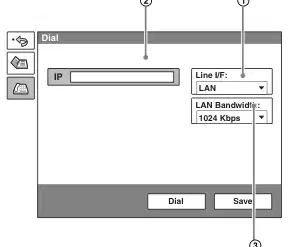
2 Select the IP text box, then enter the IP address of the remote party using the number buttons and (dot) button on the Remote Commander.
3 Select “LAN Bandwidth”, then select the bandwidth you are using.

1 Select “Line I/F”, then select “ISDN” from the displayed submenu.
2 Select the telephone number text box, then enter the telephone number of the remote party with the number buttons on the Remote Commander.
ISDN
A2
3 Select “Number of Lines”, then select the number of channels to be used when dialing the remote party.
6B
B2
3 Use the V, v, B or b button to select “Dial” in the lower part of the Dial menu, then press the PUSH ENTER button, or press the CONNECT/ DISCONNECT ( / ) button. When the System connects to the remote party, the message “Meeting starts!” is displayed and the screen turns as follows.

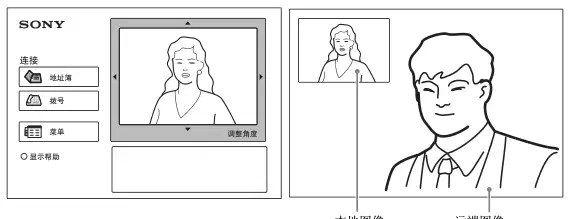
To adjust when not in communication Use the V, v, B or b button on the Remote Commander to select the picture in the launcher menu, then press the PUSH ENTER button. Press the V, v, B or b button to adjust the camera angle and the ZOOM T/W button to zoom in or out. After the adjustment, press the PUSH ENTER button.

While not in communication While in communication
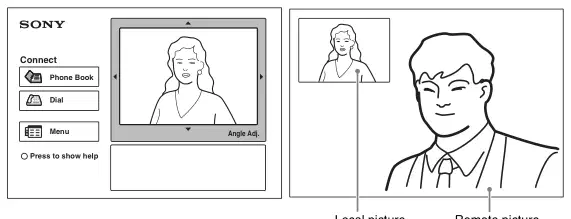
Remote picture Local picture

To adjust when in communication You can adjust the angle of the picture and zoom on the local site with the V/ v/B/b and ZOOM T/W buttons on the Remote Commander. Refer to the Operating Instructions to adjust the camera angle of the picture and zoom on the remote site.
To adjust the volume of the sound received from the remote party Press the VOLUME +/– button on the Remote Commander.
To cut off the sound of the local party sent to the remote party Press the MIC ON/OFF button on the Remote Commander. The “MIC OFF” indicator is displayed on the monitor screen. To restore the sound, press the MIC ON/OFF button again.


1 Press the CONNECT/DISCONNECT ( / ) button on the Remote Commander. The message “Disconnect?” appears on the monitor screen.

2 Press the B or b button on the Remote Commander to select “OK”, then press the PUSH ENTER button, or press the CONNECT/DISCONNECT ( / ) button. The line is disconnected and the launcher menu is restored.
1 Press the @/1 button on the Remote Commander. The message “Power Off?” appears on the monitor screen.
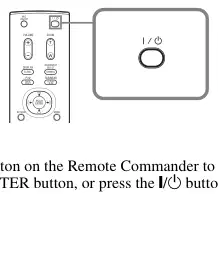
2 Press the B or b button on the Remote Commander to select “OK”, then press the PUSH ENTER button, or press the @/1 button.

The System enters standby mode, and the POWER indicator on the Communication Terminal lights in orange.
POWER indicator (Not lit.)
POWER indicator (Lights in orange.)
@/1 button
ZOOM
DISPLAY
CLEAR SYMBOL
VIDEOINPUT
SELECT
PinP FAR/NEAR BACK SPACE
NUM
B/b and PUSH ENTER buttons
RETURN MENU
When the System is in this status, you can turn it on with the @/1 button on the Remote Commander. If the system receives a call, the standby mode is automatically canceled and the system is connected.
Set the power switch on the right side of the Communication Terminal to the off position (a), and turn off other equipment used for the videoconference.

Pressing the HELP button on the Remote Commander displays a balloon help or a help screen to guide most operations on the monitor screen.

To hide the help guide, press the HELP button again.

The PCS-11/11P Video Communication System is composed of basic system components for a basic videoconference, and optional equipment for an enhanced videoconference.
The PCS-11/11P Video Communication System is the basic system of the PCS-11/11P Videoconferencing System. It contains the following components:
Contains the video codec, audio codec, echo canceler, network interfaces and system controller.
PCS-C11/C11P Camera Unit Composed of the camera and an integrated microphone.
PCS-R1 Remote Commander Used to operate the Communication Terminal and Camera Unit.
PCS-AC195 AC adaptor Supplies power to the Communication Terminal.
PCS-P11/P11P Communication Terminal

A TV or projector, etc. is required to monitor the images for videoconferencing system.
TV, Projector, etc. Used as a monitor and speakers.
The following optional devices are used to enhance your videoconference.
PCS-B384 ISDN Unit Used to connect to an ISDN line. Up to three ISDN lines; 6B channels usable.
PCS-B768 ISDN Unit Used to connect to an ISDN line. Up to six ISDN lines; 12B channels usable.
PCS-A1 Microphone Omni-directional microphone that picks up sound relatively from all directions, allowing participants to speak from any location. It is recommended to use in a quiet situation.
PCS-A300 Microphone Unidirectional microphone. It is recommended when you want to pick up the voice of a speaker directed toward the microphone.

Allows transmission of pictures to the Communication Terminal by infrared signals without connecting a cable.
Integrated microphone/speaker system suitable for remote communication. The uni-directional microphones pick up clear voice with minimum background noise. Moreover, the omni-directional speaker outputs sound equally in all directions.
Use the following connecting cables to connect devices in this system.
Cable Part No. Number
Camera cable (0.25 m (0.8 feet)) 1-827-376-11 1
S-video connecting cable (1.5 m (4.9 feet)) 1-776-078-42 1
Audio connecting cable (1 m (3.3 feet)) 1-765-258-31 1
S-video connecting cable
Audio connecting cable
17 GB System Components
PCS-DS150/DS150P Document Stand · CTE-600 Communication Transducer

This section describes the typical system connections.

AUDIO OUT AUDIO IN AUX1–VIDEO IN–AUX2 CAMERA UNIT MIC (PLUG IN POWER) ISDN UNIT


AUDIO OUT AUDIO IN AUX1–VIDEO IN–AUX2 CAMERA UNIT MIC (PLUG IN POWER) ISDN UNIT

Video, audio, data Frame format
H.221 (compliant with ITU-T
PCS-P11/P11P Communication Terminal This unit is compliant with ITU-T Recommendations H.320 and H.323.
Recommendation) Interface LAN (standard), 64 Kbps to 1024
Kbps ISDN (BRI), up to 3 lines (when
installing the PCS-B384), up to 6 lines (when installing the PCS-B768) Data transmission rate
Motion picture Operating bandwidth
64 Kbps to 1024 Kbps (standard, LAN connection) 56 Kbps to 384 Kbps (when installing the PCS-B384, ISDN connection) 56 Kbps to 768 Kbps (when installing the PCS-B768, ISDN connection) Coding H.261/H.263/H.263+/H.263++/
LSD 1.2 Kbps, 4.8 Kbps, 6.4 Kbps MLP 6.4 Kbps, 24 Kbps, 32 Kbps HMLP 62.4 Kbps, 64 Kbps, 128
Kbps LAN protocol supported
HTTP FTP Telnet RTP/RTCP TCP/UDP
H.264 (ITU-T Recommendation) Picture elements
Remote control Far end camera control
H.281 (compliant with ITU-T
NTSC (PCS-P11) PAL (PCS-P11P) Capable of connection between
T.120 (compliant with ITU-T
Still Picture Pixels 704 pixels × 480 lines (PCS-P11) 704 pixels × 576 lines (PCS-P11P) Encoding H.261 (ITU-T Recommendation)
19.5 V Power consumption
3.0 A Operating temperature
Annex. D (4CIF) H.263 (special format of this
5°C to 35°C (41°F to 94°F) Operating humidity
20% to 80% Storage temperature
Sound Bandwidth 7 kHz (G.722 compliant with ITU- T Recommendation) 3.4 kHz (G.711/G.728 compliant with ITU-T Recommendation) Transmission rate
–20°C to +60°C (–4°F to +140°F) Storage humidity
20% to 80% (no condensation) Dimensions 258 × 54 × 171 mm (w/h/d) (10 1/4 × 2 1/4 × 6 3/4 inches) (not including the projected parts) Mass Approx. 1.3 kg (2 lb 14 oz) Supplied accessories
56 Kbps, 64 Kbps (G.711 compliant with ITU-T Recommendation) 48 Kbps, 56 Kbps, 64 Kbps (G.722 compliant with ITU-T Recommendation) 16 Kbps (G.728 compliant with ITU-T Recommendation)
Remote Commander PCS-R1 (1) Size AA (R6) batteries for Remote
Commander (2) IR repeater (2) Camera cable (0.25 m, 0.8 ft) (1) S-video connecting cable (1.5 m,
4.9 ft) (1)

Audio connecting cable (1 m, 3.3
Control DC 3V using two size AA (R6)
ft) (1) AC adaptor PCS-AC195 (1) Power cord (1) 21-pin adaptor (1) (PCS-P11P only) Velcro (3 for the Camera Unit, 2
batteries Dimensions 50 × 24 × 197 mm (w/h/d) (2 ×
31/32 × 7 7/8 inches) (not including the projected parts) Mass Approx. 140 g (4 oz) (including
for the Communication Terminal) CD-ROM (1) Operation guide (1) Warranty booklet (1)
100 to 240V AC, 50/60 Hz, 1.3 A to 0.6 A Output 19.5 V, 4.1A Operating temperature
5°C to 35°C (41°F to 94°F) Operating humidity
NTSC color, EIA standards (PCS-
C11) PAL color, CCIR standards (PCS-
20% to 80% Storage temperature
–20°C to +60°C (–4°F to +140°F) Storage humidity
1/4 type CCD (Charge Coupled Device) Approx. 410 000 pixels (Effective:
20% to 80% (no condensation) Dimensions 63 × 31 × 140 mm (w/h/d) (2 1/2 × 1 1/4 × 5 5/8 inches) Mass Approx. 410 g (14 oz)
approx. 380 000 pixels) (PCS- C11) Approx. 470 000 pixels (Effective:
approx. 440 000 pixels) (PCS- C11P) Lens f = 3.1 to 31 mm, F 1.8 to 2.9,
Bandwidth 13 kHz Directional characteristic
Horizontal angle 6.6° to 65° Focal distance
Omnidirectional Dimensions 74 × 16 × 93 mm (w/h/d) (3 × 21/32 × 3 3/4 inches) Mass Approx. 170 g (6 oz) Power Plug in power
100 (WIDE) to 600 (TELE) mm Minimum illumination
3.5 lux at F 1.8/50 IRE Illumination range
3.5 lux to 100 000 lux Horizontal resolution
470 TV lines (PCS-C11) 450 TV lines (PCS-C11P) Pan/tilt action
Bandwidth 13 kHz Directional characteristic
Unidirectional Dimension 68 × 16 × 96 mm (w/h/d) (2 3/4 ×
Horizontal ±100° Vertical ±25° Dimension 147 × 130 × 138 mm (w/h/d) (5 7/8 × 5 1/8 × 5 1/2 inches) (not including the projected parts) Mass Approx. 1.1 kg (2 lb 7 oz)
21/32 × 3 7/8 inches) Mass Approx. 200 g (7 oz) Power Plug in power
19.5 V Power consumption
18 kHz Directional characteristic
0.3 A Operating temperature
5°C to 35°C (41°F to 94°F) Operating humidity
20% to 80% Storage temperature
–20°C to +60°C (–4°F to +140°F) Storage humidity

20% to 80% (no condensation) Dimensions 165 × 34 × 127 mm (w/h/d) (6 1/2 × 1 3/8 × 5 inches) (not including the projected parts) Mass Approx. 400 g (14 oz) Supplied accessories
Interface cable (5 m, 16.4 ft) (1) Operating Instructions (1) Warranty booklet (1)
19.5 V Power consumption
0.5 A Operating temperature
5°C to 35°C (41°F to 94°F) Operating humidity
20% to 80% Storage temperature
–20°C to +60°C (–4°F to +140°F) Storage humidity
20% to 80% (no condensation) Dimensions 165 × 34 × 127 mm (w/h/d) (6 1/2 × 1 3/8 × 5 inches) (not including the projected parts) Mass Approx. 400 g (14 oz) Supplied accessories
Interface cable (5 m, 16.4 ft) (1) Operating Instructions (1) Warranty booklet (1)
Design and specifications are subject to change without notice.
Power requirements


ࣴ᠆ Adobe Acrobat Reader 5.0 (E) ᠳޗૣ ሇᐄᑏϔࣴ ᠆ Adobe Acrobat Reader 5.0 (E)
ெᎢᠳЫᐾϽҋᅶ PCS-11P ѕᡩᆀ ᠺᐹ፨صਥဿտဿᆀᠺѕᡩሇ߰ ല౯Ѹ ಲ
Windows NT ®**
4.0 Service Pack 5
ظмЭмλᒧ፠ԏᤝᚊ੧ഡಱႝ ലሇ Adobe Acrobat Reader
ᐄᑏሇ౯Ѹᢪұࣘ ޗᰁሇ CD- ROM ϔ
ૣ᱇ᠳλ Adobe ® Acrobat ®* Reader ൌᯛᢱಞ
ૣ ሇᡝᎨസϔണࣴ ᠆ Adobe Acrobat Reader
http://www.adobe.com/products/acrobat/ readstep.html ๔༬ႝ ല
http://www.adobe.com/products/acrobat/ acrrcenteuro.html ೃಞႝ ല
1 यඓണ
Manuals for Video Communication System
http://www.adobe.co.jp/products/acrobat/ readstep.html
ሇ CD- ROM ఠԗᡝᎨസሇ CD-ROM ᳳ֬ ݥϔ
ፑحϔ೪ዥϽ CD-ROM ϔׇ ٢ሇಞх
य٦֬ Adobe Acrobat Reader
* Adobe ڔ Acrobat ϛ Adobe Systems, Incorporated ሇ۵ඓ
** Windows ڔ Windows NT ϛᒼދڔԢ࣯ ދए Microsoft Corporation ሇ༉ԯ۵ඓ


1 ୧ਥᆀᠺሠᠺݥ
2 ୧ਥѕᡩᆀᠺᐹ፨᱇ᠳҋᅶሇԢ࣯ ᡷࠩ ᆀྶ
3 यѕᡩᆀᠺᐹ፨ࠨᄮݥؼҜሇᆀྶ ਥԟ୧տ ( @ ) Ѭᒳ

ѕᡩᆀᠺᐹ፨ࠨᄮݥ֏ᱤሇ 3 ϑெዥဢڔѕᡩᆀᠺᐹ፨ే ӵസκሇ POWER ெዥဢبК
ᰡَ سണ ύعᡷࠩ κሇ POWER ெዥဢδር೪ዥϛᑬᗡ
ሠᠺݥ॓ ২κѕՠ ᄕ٦֬ ᚚת
٦֬ ᚚתϔѕ೪ዥലಲѕᡩᆀᠺᐹ፨ే ӵസే ሇތӵ

٦֬ ᚚתмᨉఉPCS-B768 ISDN าޮ ሇჁՃϛތዥሇ
5 CS ୧ਥᐄᑏ

1 ைᩎఊݥκሇ V
ၦَ ை PUSH ENTER ைᬋୈை CONNECT/DISCONNECT ( ȏ ) ை ᬋ
வؿ
வؿ
ᚚת

ᚚת
CS 6 ڍشनಲ
ᨅّૣ ЫᐾѲڍشര༉ԯտޞޤᏔϔሇनಲ · ሠᠺݥ॓ ২κՠᄕ

ၦَ ை PUSH ENTER ை ᬋ
B ୈb ைᬋᨢஶᠳᡷᒳሇᲇሩ

ૣ ᨭ᧼ LAN ᨉఉनಲ
1 ᨢஶ
ၦَ Э೪ዥሇ࣒ ᚚתϔᨢஶ
ᐰጕᏚ

2 ᨢஶ IP ಞലන
ၦَ ҋᅶᩎఊݥκ ሇಚࣗ ைᬋڔ ( ဿ) ைᬋ᧢ԗ IP ޞޤ
ၦَ ᨢஶૣ ҋ ᅶሇऒ
7 CS ڍشनಲ
ᚚתϔሇᲇሩ · ҋᅶV

1 ᨢஶ
ၦَ Э೪ዥሇ࣒ ᚚתϔᨢஶ
ᐰጕᏚ
ISDN
2 ᨢஶᆀᢔؿኇಞലන
ၦَ ҋᅶᩎఊ ݥκሇಚࣗ ைᬋ᧢ԗनಲሇᆀᢔؿ ኇ
ሣവᒬಢ
ISDN
A2
3 ᨢஶ
ဧሣവၫ݄
B1
6B
B2
ۣ ࡀ
3 ҋᅶ V
B ୈb ைᬋᨢஶ
வؿ
வؿ
ୈᓥை CONNECT/DISCONNECT ( ȏ ) ைᬋ
CS 8 ڍشनಲ

B ୈb ைᬋᨢஶ٦֬ ᚚתϔሇތӵ
ை ZOOM T/W ை ᬋᒓಇތӵ
B ୈb ைᬋᢹಜѕᡩᆀᠺᐹ፨ే ӵസᡅ

ޗരᨆᨭᡪᢹಜ ҋᅶᩎఊݥκሇV · ᨇ፨ތӵ ലޞތӵ

༉ଐ
ᨅඥӟѕώ௬ޫ ѕ ᡩᆀᠺᐹ፨ే ӵസୈᓥѕᡩᆀᠺᐹ፨ࠨᄮݥ
νᠳय 100BASE-TX/10BASE-T ఉحξᆀ؊ᥑ᧼Ღࣽ Ӗሇ ᒧᑌᨉఉ

AUDIO OUT AUDIO IN AUX1–VIDEO IN–AUX2 CAMERA UNIT MIC (PLUG IN POWER) ISDN UNIT
ኵұԟᯄϽണᡷࠩ

ᨅඥӟ ѕώ௬ޫ ѕᡩᆀᠺᐹ፨ే ӵസ
ѕᡩᆀᠺᐹ፨ࠨᄮݥظᕜѕסᐜ ISDN าޮ ሇᧁх

AUDIO OUT AUDIO IN AUX1–VIDEO IN–AUX2 CAMERA UNIT MIC (PLUG IN POWER) ISDN UNIT
ѕᡩᆀᠺᐹ፨ࠨᄮݥୈᓥ ISDN าޮ · νᠳԟᯄѕᡩᆀᠺᐹ፨ࠨ ᄮݥ · ٞմѕफᖮᐄᑏՠᄕಉᰧ

ᠸඨᢪ
ಚ௳ ඨਭ H.221 ( ى ITU-T ሇਢᡩ) ఉح LAN ( ඓՋ )
64 Kbps տ 1024 Kbps ISDN (BRI)
࠰᧷ 3 ോᐰ
ࣴ ᠆ሇ PCS-B384
࠰᧷ 6 ോᐰ
ࣴ ᠆ሇ PCS-B768
༰֬ ތӵ ষѸऒ 64 Kbps տ 1024 Kbps( ඓՋᨱ
LSD 1.2 Kbps, 4.8 Kbps, 6.4 Kbps MLP 6.4 Kbps, 24 Kbps, 32 Kbps HMLP 62.4 Kbps, 64 Kbps, 128
LAN ᨉఉ) 56 Kbps տ 384 Kbps ( ᠆ PCS- B384
Kbps ಀ LAN צᡩ
ISDN ᨉఉ) 56 Kbps տ 768 Kbps ( ᠆ PCS- B768
HTTP FTP Telnet RTP/RTCP TCP/UDP
H.264 (ITU-T ਢᡩ) ӵᐆ CIF: 352 ӵᐆ
144 ᗡցਭ PAL ظмᨉఉύጕᗡցਭ
ᱟތႜ ӵᐆ 704 ӵᐆ
H.281 ( ى ITU-T ਢᡩ) ಚ௳љ᧢ T.120 ( ى ITU-T ਢᡩ)
576 ᒁኇ H.261 (ITU-T ਢᡩ) Annex. DD
δᗇ؝ಚ ᆀྶ ᠳຸ 19.5 V ᓯ 3.0 A ষѸྛ 5°C տ 35°C ষѸྰ 20% տ 80% ಇྛ –20°C տ +60°C ಇྰ 20% տ 80% ( ುາ໑ՅՓ ) ध 258
ᲀ ऒ 7 kHz
G.722
3.4 kHz
G.711/G.728
171 ຐᏘ ( ऒ/ ᴱ/ ؏ ) ( ν٢ஃоᐵх ) ࠵ᐛ 1.3 ןԎ ᰡസᰁх ᩎఊݥ PCS-R1 (1) ᅶЃᩎఊݥሇ AA (R6) ᆀໆ (2) ᐗᐰᦾؤݥ (2)
љ᧢ᨱᄈ 56 Kbps, 64 Kbps
G.711
48 Kbps, 56 Kbps, 64 Kbps (G.722, ى ITU-T ਢᡩ) 16 Kbps
G.728
ӵസᆀᑳ (0.25 Ꮨ) (1) S-Video ᨉఉᆀᑳ (1.5 Ꮨ) (1) ᲀᲝᨉఉᆀᑳ (1 Ꮨ) (1) Б༴ᆀྶ ݥ PCS-AC195 (1) ᆀྶ ᐰ (1) 21 Ꭻᕫᦾఉݥ (1) ᑢظႧॆ Ḛు୫ (3 ϑᅶЃѕᡩ ᆀᠺᐹ፨ే ᣳസ
2 ϑᅶЃѕ ᡩᆀᠺᐹ፨ࠨᄮݥ) CD-ROM (1) ౯ѸᢪϷ (1) ᤌұϷ (1)
ᲀᲝ · ಚ௳љ᧢ᨱᄈ · ᩎఊ ᨇጫే ӵസఊց

PCS-B384 ISDN าޮ
ظᨢ
ᠺᲝҴؿ PAL ցਭ, CCIR ඓՋୄ ӵԈх 1/4 ߉ CCD ( ᆀᙰᓶىᡷࠩ ) ᐛ 47 ηӵᐆ ( ണಊӵᐆ
ᆀྶ ᠳຸ 19.5 V ᓯ 0.3 A ষѸྛ 5°C տ 35°C ষѸྰ 20% տ 80% ಇྛ –20°C տ +60°C ಇྰ 20% տ 80% ( ುາ໑ՅՓ ) ध 165
ᐛ 44 ηӵᐆ) ࠽ f = 3.1 տ 31 ຐᏘ, F 1.8 տ 2.9,
ే ᥭጌ 100
127 ຐᏘ ( ऒ/ ᴱ/ ؏ ) ( ν٢ஃоᐵх ) ࠵ᐛ 400 Ԏ ᰡസᰁх ఉحᆀᑳ (5 Ꮨ) (1) ౯Ѹᢪ (1) ᤌұϷ (1)
ᨇᥭ
ຐᏘ ഡलၯ F 1.8/50 IRE ോхλ 3.5 lux ၯᘲއ 3.5 lux տ 10 η lux າ৮թ᧯ᄈ 450 TV ᐰ Ԙ/ ӗಧ າ৮ ±100
ॄध 147
138 ຐᏘ ( ऒ/ ᴱ/ ؏ ) ( ν٢ஃоᐵх ) ࠵ᐛ 1.1 ןԎ
ظᨢ
ᆀྶ ᠳຸ 19.5 V ᓯ 0.5 A ষѸྛ 5°C տ 35°C ষѸྰ 20% տ 80% ಇྛ –20°C տ +60°C ಇྰ 20% տ 80% ( ುາ໑ՅՓ ) ध 165
ԎᲰ Ოᄈᘲއ 18 kHz ಲّ Ⴏપ लᡅّࣽ
127 ຐᏘ ( ऒ/ ᴱ/ ؏ ) ( ν٢ஃоᐵх ) ࠵ᐛ 400 Ԏ ᰡസᰁх ఉحᆀᑳ (5 Ꮨ) (1) ౯Ѹᢪ (1) ᤌұϷ (1)
Ҵؿඨਭ ᐗ SIRCS ఊց DC 3V 2 ᗩ AA (R6) ᆀໆॄ ध 50
197 ຐᏘ ( ऒ/ ᴱ/ ؏ )
PCS-AC195 Б༴ᆀྶ ݥ
ᡷᡝڔᠸඨണഛಅ
ᆀྶ ᠳຸ 100 տ 240V AC, 50/60 Hz, 1.3 A տ 0.6 A ᧢ՠ 19.5 V, 4.1A ষѸྛ 5°C տ 35°C ষѸྰ 20% տ 80% ಇྛ –20°C տ +60°C ಇྰ 20% տ 80% ( ುາ໑ՅՓ ) ध 63
140 ຐᏘ ( ऒ/ ᴱ/ ؏ ) ࠵ᐛ 410 Ԏ
ظᨢ
ऒ 13 kHz ಲّ Ⴏપ Ԙّॄ ध 74
93 ຐᏘ ( ऒ/ ᴱ/ ؏ ) ࠵ᐛ 170 Ԏ ᆀྶ ఠԗਭᆀྶ
ظᨢ
ऒ 13 kHz ಲّ Ⴏપ תّॄ ध 68
96 ຐᏘ ( ऒ/ ᴱ/ ؏ ) ࠵ᐛ 200 Ԏ ᆀྶ ఠԗਭᆀྶ
I possessori del prodotto e il nostro team di solito rispondono entro 24 ore, e la tua domanda sarà utile anche ad altri.
Invia la prima domanda: risponderanno altri possessori o il nostro team.